
"cool climate coffee"
3000 article(s) found

How do you brew Rwandan Gesak coffee? What is the flavor of Rwandan coffee?
In recent years, Rwandan coffee has attracted public attention with its high-quality water-washed bourbon. In this issue, baristas will share the brewing methods of Rwandan coffee. Rwanda coffee is known as the country of thousands of hills, Rwanda, the whole territory is mountainous and plateau, most areas are tropical plateau climate and savanna climate, mild and cool. There are about 33000 hectares of coffee plantations, 500000 people from

Introduction of American Hawaiian coffee beans with moderate acidity of volcanic black mud
The quality of the fine Kona coffee is suitable for the right geographical location and climate. Coffee trees grow on the slopes of volcanoes, and their geographical location ensures the altitude needed for coffee to grow; the dark volcanic ash soil provides the necessary minerals for coffee. This is probably due to the fact that Kona Island is rich in volcanic black mud with moderate acidity, rich mineral content and suitable water content. Parallel

Introduction to the producing area of Guatemala Coffee Bean Variety and Flavor description treatment
The flavor description method of Guatemalan coffee beans accounts for 85% of the total coffee production, including Brazil, Colombia, Guatemala, Ethiopia and so on. The beans are turquoise, thin and small, with special aroma and sweet acid, which is good to drink with other coffee. Excellent quality, more suitable for public taste. Robusta species: roughly

Introduction to the Flavor of Nicaraguan Coffee in five Major Coffee producing areas
Communication of professional baristas Please pay attention to Coffee Workshop (Wechat official account cafe_style) Nicaraguan coffee is mainly produced in the central and northern parts of Nicaragua, covered with volcanic ash and shaded by trees, resulting in high-quality Nicaraguan coffee, which has a mediocre, mild flavor and is suitable for mixed coffee. Shade planting is its characteristic, while coffee beans are washed and dried in the sun.

A brief introduction to the cultivation of slightly bitter Aldu Mara boutique coffee beans, geographical location, climate and altitude
Mexico has a long history of producing coffee and is currently one of the most important coffee producing countries in the world. The coffee produced in Mexico is naturally called Mexican coffee. About 5 ℃ of Mexico's national area are plateaus and mountains, with an annual average temperature of 2527 ppm. The Mexican plateau has a mild climate all the year round, with mostly plateau topography, no severe cold in winter, no heat in summer, and ten thousand trees in four seasons.

Description of roasting flavor of Nicaraguan coffee beans
The exchange of professional baristas please pay attention to the coffee workshop (Wechat official account cafe_style) the words (S.H.G) are printed on the bean bags of the fine Nicaraguan coffee city, representing coffee produced by high-altitude estates. The segovia region is located on the high platform in the north, an outstanding and unique area composed of cooperatives. Light baked City (fragrance): lemon grass, slightly citrus

2018 how to cook Rwanda coffee beans in Hu Yeshan _ introduction to the flavor characteristics of Rwanda washed bourbon coffee
Professional coffee knowledge exchange more coffee bean information please follow coffee workshop (Wechat official account cafe_style) Rwanda washed bourbon coffee, Rwanda is known as the country of a thousand hills, the whole territory is mountainous and plateau, most areas are tropical plateau climate and savanna climate, mild and cool. There are about 33000 hectares of coffee plantations and 500000 people are engaged in the coffee industry. Have a high altitude

Introduction to the Fine Coffee Kona Coffee Flavor Manor
Kona coffee is suitable for the right geographical location and climate. Coffee trees grow on the slopes of volcanoes, and their geographical location ensures the altitude needed for coffee to grow; the dark volcanic ash soil provides the necessary minerals for coffee. This is probably due to the fact that Kona Island is rich in volcanic black mud with moderate acidity, rich mineral content and suitable water content. And every day

A brief introduction to the cultivation of Nicaraguan boutique coffee beans with citrus, geographical location, climate and altitude
Nicaragua is now one of the poorest countries in Central America. Due to its poor economic foundation, the coffee industry is still relatively backward, while coffee farmers are in extreme poverty. Fortunately, Nicaraguan coffee has received some foreign aid funds to improve the quality of its coffee. Coffee from Madagelba, Sinodega and Segovia in Nicaragua

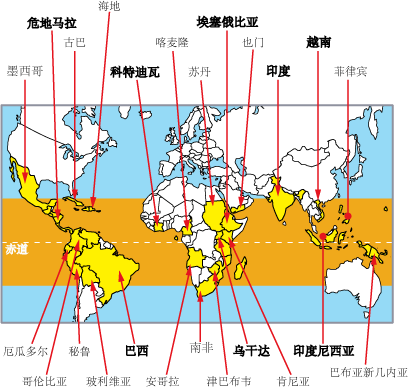
World Coffee Map-- A Collection of Information on Coffee producing areas in Central America and Nicaragua
Communication of professional baristas Please pay attention to Coffee Workshop (Wechat official account cafe_style) Nicaraguan coffee is mainly produced in the central and northern parts of Nicaragua, covered with volcanic ash and shaded by trees, resulting in high-quality Nicaraguan coffee, which has a mediocre, mild flavor and is suitable for mixed coffee. Shade planting is its characteristic, while coffee beans are washed and dried in the sun.

Characteristics of Dominica coffee beans in Dominica coffee producing areas
The Dominican Republic is a popular country for travelers. It lives next to Haiti on the island of Hispaniola in the West Indies, Dominica in the west and Haiti in the east. The whitest and softest white sand in the world, the cool sea breeze from the Atlantic and Caribbean and the warm sunshine in the tropics make it a holiday paradise on a par with Maldives and Hawaii.

Guatemala Flower God Coffee Planting Situation Location Climate Elevation Profile
Coffee was introduced to Guatemala in 1750 by Father Jesuit, and German colonists developed the coffee industry in the late 19th century. Today, most of the coffee industry is produced in the south of the country. Guatemala has seven major coffee producing areas, each producing area produced by the coffee flavor is different, but in summary, Guatemala coffee are

Introduction of high quality Nicaraguan coffee
Nicaragua is located in central Central America, bordered by the Pacific Ocean to the west and the Caribbean Sea to the east. The highlands in the north and the coastal plains in the east are part of the Central American volcanic belt. The eastern plain is high-temperature and rainy, with a tropical maritime climate. The suitable climate provides an excellent growth environment for the cultivation of coffee. High-quality Nicaraguan coffee, grown in the north and middle of the country. Coffee is Ni.

How to taste Nicaraguan coffee
Following Kaibei (Wechat official account vdailycom) found that the Beautiful Cafe opened a small shop of its own Nicaragua is located in central Central America, it is bordered by the Pacific Ocean to the west and the Caribbean Sea to the east. The highlands in the north and the coastal plains in the east are part of the Central American volcanic belt. The eastern plain is high-temperature and rainy, with a tropical maritime climate. The suitable climate provides excellent for the cultivation of coffee.

Hawaiian Kona Coffee Flavor introduction Hawaiian Coffee Bean Fine Coffee
The quality of the fine Kona coffee is suitable for the right geographical location and climate. Coffee trees grow on the slopes of volcanoes, and their geographical location ensures the altitude needed for coffee to grow; the dark volcanic ash soil provides the necessary minerals for coffee. This is probably due to the fact that Kona Island is rich in volcanic black mud with moderate acidity, rich mineral content and suitable water content. Parallel

Which are the eight producing areas of Guatemalan coffee in Guatemala?
For the exchange of professional baristas, please pay attention to the coffee workshop (Wechat official account cafe_style). The latitude of Guatemala is about 15 degrees, because of the long mountains and great regional climate changes, which have created the eight major coffee producing areas of the country, all located on the highland topography under the subtropical climate, rich and stable rainfall, excellent environment for fertile volcanic ash soil, and the coffee they produce.
Guatemala Antigua Coffee Starbucks Guatemala Antigua Starbucks Guatemala Coffee beans
The Antigua Valley (AntiguaValley) is the oldest and best-known coffee producing area in Guatemala. Volcanoes and extremely shallow groundwater levels form a dry microclimate, characterized by low humidity, adequate sunshine and cool nights. Antigua is a closed valley surrounded by three volcanoes: Agua, Acatenango and

The cultivation of boutique coffee beans in the most famous Cochell manor in Africa, geographical location, simple climate, simple altitude
At first, Yejassefi's coffee trees were planted by European monks, and later by farmers or cooperatives. Yega Xuefei is actually constructed by the surrounding coffee communities or cooperatives, including: Hafusha, Hama, Biloya. These mountain villages are foggy, like spring all the year round, with a gentle breeze in summer, cool but not hot, rain but not damp, and no cold damage in winter.
Coffee Grinding degree, taste and Flavor of La Tisa Manor in Guatemala
Antigua Island (Antigua) is a famous producer of coffee. Rich volcanic soil, low humidity, strong sunlight and cool night winds are the characteristics of Antigua. Three spectacular active volcanoes ── Agua, Acatenango and Fuego form a beautiful valley. Fuego active volcano also adds misty dust from time to time. Every 30

Flavor and taste characteristics of Guatemalan coffee producing areas introduction of high-quality coffee beans
Guatemala is located in the tropics, the northern and eastern coastal plains have a tropical rain forest climate, the southern mountains have a subtropical climate, the year is divided into two dry and wet seasons, with the wet season from May to October and the dry season from November to April of the following year. The narrow and fertile flatlands on the Pacific side of Guatemala have a tropical climate. The central plateau is also the cultural center of Guatemala, where the year-round temperature ranges from 1300 to 1800 meters.